Set It Right,
From Day One.
Your watch arrived running, but a mechanical movement deserves a proper start. This guide covers winding, time-setting and every complication in the collection — crown by crown, click by click.
Screw the crown back down after every adjustment — every single time. The screw-down crown is what seals the case against water. Skip it once after a shower and you may find fog on the inside of the crystal.
Submariner & GMT-Master II
These two share the same movement architecture in super clone form, so the crown behaves identically on both: same positions, same winding direction, same hacking seconds. The one difference that matters is the GMT's independent 24-hour hand — covered below.
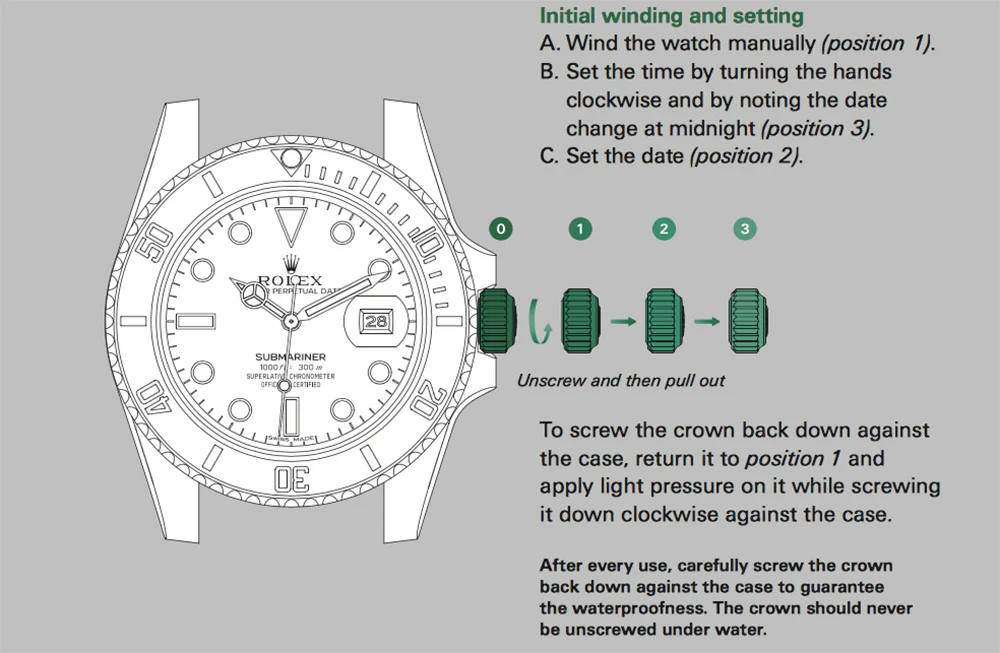
Crown screwed down flush against the case. The watch is closed, and water resistance depends on it staying exactly here.
Crown loose and sitting closest to the case. This is where manual winding happens.
On the Submariner Date, this click quick-sets the date. On the GMT-Master II, the same click jumps the local hour hand in one-hour steps and rolls the date along with it.
The seconds hand stops — that is the hacking feature — so you can sync the hands to a reference clock to the second.
Waking the movement up
Turn the crown counterclockwise until it pops free into Position 1.
You will feel resistance build as the mainspring charges. Counterclockwise winding does nothing on these movements — it harms nothing, but the balance wheel will not wake up either.
Use Positions 2 and 3 as needed — the date section below has the one timing rule to respect.
Push the crown in and screw it down until snug. Daily wear and the rotor keep it charged from here — most 31xx-class movements hold roughly 48 hours of reserve.
The 8 PM to 4 AM window
Inside that window the date-change gears are partially meshed, and forcing the quick-set can shear teeth off the date wheel. Not sure whether the watch reads AM or PM? Pull to Position 3, advance the hands until the date snaps — that is midnight — park the time at 6:00, set the correct date at Position 2, then return to Position 3 and set the real time. Thirty seconds of ritual, decades of reliability.
The four-step GMT sequence
Position 3: the minute hand and the 24-hour GMT hand move together to your reference zone.
Position 2: jump the standard hour hand in one-hour clicks. The 24-hour hand stays put; the date follows the local hour.
Rotate the GMT bezel against the 24-hour hand for an at-a-glance third timezone.
A crisp, positive one-hour jump is also a quality tell — if the hand drifts or lands between markers, the movement may not be the grade you were promised.
Daytona
Two extra pushers, three subdials, and a central chronograph seconds hand that sweeps when activated. The Daytona is also where grades show fastest: a proper super clone runs a 4130-based movement with running seconds at 6, the 30-minute counter at 3 and the 12-hour totalizer at 9 — exactly like the genuine layout.
Winds and sets time like the Submariner. No date complication means just two working positions: neutral for winding, pulled out for time-setting.
Starts and stops the chronograph. The central hand sweeps while the small seconds at 6 keeps its own rhythm.
Resets the chronograph hands to zero — but only after the chronograph has been stopped. This ordering is the whole game.
Tracks chronograph minutes up to thirty, then starts over.
Moves all the time, timed or not. It is your pulse check: if it is ticking, the movement is alive.
For longer timing sessions, up to a full half-day of elapsed time.
The reset lever engages moving gears, and that collision can chip wheels, bend pivots or jam the whole module — true on genuine and clone calibers alike. Stop with the top pusher first, then reset. Every time. No shortcuts.
Crown screwed down. Normal wearing mode.
Manual winding. Give it 30 to 40 clockwise turns if the watch has been sitting.
Time-setting only — the Daytona has no date. The small seconds hand hacks here so you can sync precisely.
Sky-Dweller
The most complicated dial in the catalog: annual calendar, dual time zones, month display. Super clones simplify the genuine Ring Command system — the month sets by direct bezel rotation and everything else runs through standard crown positions. Less to go wrong, same result on the dial.
Crown screwed down. Normal wearing mode.
Manual winding — same drill as every other model.
Clockwise rolls the date forward; counterclockwise rotates the 24-hour home-time disc until the red arrow points at your home hour.
Sets local time on the center hands. In most clones the hour hand jumps independently in one-hour steps — ideal for travel without disturbing home time.

Face-up, rotate the fluted bezel — usually counterclockwise — until the red marker lines up with the correct month aperture: January at 1 o'clock through December at 12. Purely manual, once a month, no crown needed.
Position 2: clockwise for the date, counterclockwise for the 24-hour disc. The disc's red triangle reads AM from PM at a glance — 6 is 6 AM, 18 is 6 PM.
Position 3: the hour hand jumps in clean one-hour increments without disturbing the disc. Cross midnight and the date rolls over on its own.
Screw the crown down. Local time on the hands, home time on the disc, date at 3 o'clock, month in red — four readings from one dial.
Datejust & the Three-Hand Models
Datejust, Air-King, Explorer, Oyster Perpetual — every three-hand model in the collection follows the exact process as the Submariner Date: Position 1 winds, Position 2 quick-sets, Position 3 sets the time. The 8 PM to 4 AM rule applies to all of them. Whatever the dial, bezel or bracelet, the crown operation never changes — set one and you have set them all.
Six Habits From the Bench
Half of these are standard watchmaker advice. The other half we learned the hard way, handling these movements every day.
Pulling the crown while it is strapped on side-loads the stem where it enters the case tube. Slide the watch off, set it, put it back on. Five extra seconds.
A grinding feel usually means debris in the crown tube threads. Forcing it can cross-thread the tube — a repair that needs the case opened. Have it looked at.
Finger-tight is enough. Cranking harder does not improve water resistance; it just wears the threads faster. Stop at firm resistance.
Crown down first, then a fresh-water rinse after ocean or pool. Salt and chlorine residue eat rubber gaskets; a 30-second rinse prevents that maintenance entirely.
Most 31xx-class movements hold around 48 hours; newer 32xx-type platforms reach roughly 70. Dying overnight after a full wind and a full day of wear means the movement wants a service — book it in.
Advancing the hands keeps the gear train under normal load. Reverse running adds stress to the setting wheel and cannon pinion. Most movements tolerate it — why add it?
Frequently Asked
Three working positions after unscrewing. Position 1 winds the movement, Position 2 quick-sets the date on the Sub or jumps the GMT hour hand, and Position 3 sets the time with hacking seconds.
No. Stay out of the 8 PM to 4 AM window, when the date-change gears are partially meshed. Forcing the quick-set inside that window can chip the date wheel. Advance the hands through midnight first if you are unsure whether the watch reads AM or PM.
Unscrew the crown counterclockwise to Position 1, wind clockwise 30 to 40 turns for a full charge, then screw the crown back down. Daily wear and the automatic rotor will keep it running after that.
Home time first at Position 3 — minute hand and 24-hour hand move together. Then Position 2 to jump the local hour hand in one-hour steps. The date follows the local hour hand and rolls over at midnight.
Two live: local time on the center hands and home time on the 24-hour hand. For a third zone, rotate the bezel against the 24-hour hand and read it at a glance.
Never. The reset lever meets moving gears and the collision can chip wheels or jam the module — on genuine and clone calibers alike. Stop with the top pusher first, then reset.
The 3 o'clock subdial counts elapsed chronograph minutes up to 30, the 9 o'clock subdial counts elapsed hours up to 12, and the 6 o'clock subdial is the running seconds — it moves all the time, whether you are timing anything or not.
Rotate the fluted bezel until the red marker lines up with the correct month aperture — January sits at 1 o'clock through December at 12. It is a manual adjustment you make at the start of each month. No crown involvement needed.
The genuine watch couples the bezel to a Ring Command selector. Clones use direct bezel rotation for the month and standard crown positions for everything else. The result on the dial is nearly identical and simpler to operate.
Screw the crown down clockwise until snug — every time, no exceptions. That single habit maintains the water-resistant seal, and forgetting it is the most common cause of moisture under the crystal.
Set once, worn for years.
Curious what is inside the case you just set? Our craftsmanship walkthrough covers the movements, materials and bench checks behind every reference — and our reviews page shows what owners say after the first month.
Explore Craftsmanship Read Buyer Reviews